30 years later, Fargo is still the Coen Brothers’ most honest movie about greed, consequence, and everyday decency.
There’s a shot near the beginning of Fargo that I think about more than almost any other image in 1990s American cinema. It’s the opening shot, really. We see a tan Oldsmobile Cutlass Sierra, towing another Cutlass on a trailer, emerging from a wall of white. The blizzard is so complete that there is no visible horizon. There is no sky and no ground, just white and the sound of wind and then these two cars arriving out of nothing. As if they’ve been manufactured by the storm itself.
Carter Burwell‘s score comes up — that Norwegian folk melody, slow and accumulating, built on a song about a lost sheep. And before we hear a single word of dialogue, you already know everything you need to know about this movie.
You know it’s about people who can’t find their way home. You know the landscape doesn’t care about people at all. And you know something terrible is going to happen. Maybe that the terrible thing will be, at its root, pathetically small.
The blizzard that tells the whole story.
Fargo came out wide on March 8, 1996. 30 years ago today. And it immediately became the movie that everyone agreed was the best film of that year, which was otherwise not a great year for American cinema. (Roland Emmerich‘s Independence Day was the dominant blockbuster. Make of that what you will.)
Roger Ebert named it the best film of 1996 and later ranked it fourth on his list of the decade’s finest. (He also called it one of the best movies he’d ever seen at the time). It won two Oscars, earned seven nominations, and the National Film Registry selected it for preservation a decade after its release, making it one of the fastest films to receive that designation. The FX anthology series it spawned ran for five seasons and is generally regarded as one of the best things television did in the 2010s.
None of that is what makes Fargo important, though. What makes Fargo important is that it understood something about evil that most movies never approach. Evil is often boring. It’s stupid. It proceeds not from darkness or malevolence or even self-awareness, but from the most ordinary, defeated human impulse. The feeling that you deserve more than you have. And the catastrophic inability to figure out what that means.
The smallness at the center of Fargo.
Here’s what Jerry Lundegaard wants. He wants enough money to stop feeling small.
That’s the whole movie, really. William H. Macy plays Jerry — the executive sales manager at a Minneapolis dealership, crushed under the thumb of his contemptuous father-in-law Wade, in some kind of financial trouble that the film deliberately never specifies — and from the first scene, which is Jerry’s dinner meeting with the two criminals he’s hired to kidnap his wife, the performance is a portrait of a man whose self-image and actual competence have never once overlapped.
Jerry can’t finish a sentence. He starts, he hedges, he pivots, he circles back. He’s committed to this horrifying scheme and he cannot get through the logistics of it without stammering.
Joel Coen said later on that he and Ethan hadn’t fully realized what a difficult acting challenge they’d written. Jerry is, he observed, a fascinating mix of the completely ingenuous and the utterly deceitful. He’s a man who set terrible events in motion and is genuinely surprised when they go wrong. That paradox is the film’s moral engine.
Jerry isn’t really a monster.
Jerry doesn’t want anyone to die. He wants money. And in the Coen brothers‘ universe, which is a universe governed by the logic of consequence, that distinction doesn’t matter at all. Because the dead state trooper on the highway is as dead as he would be if Jerry had wanted him dead. The dead woman on the floor of the cabin is just as gone. The absence of murderous intent doesn’t undo the presence of murder.
In this way, the film is a meditation on what it costs to be incapable of thinking past yourself. That cost, in Fargo, is everyone around you.
What the Coens do with this premise that is so unusual — what still feels radical even decades later — is that they don’t explain it. They don’t give Jerry a backstory that contextualizes his desperation. They don’t show us the debt or the deal that went wrong or the formative humiliation that turned him into this. No, they just show us a man who’s already made the decision, already set the mechanism in motion, and they let the mechanism run.
The film is interested in consequences, not psychological theories. It’s a morality play. It has the formal architecture of a morality play, with Marge Gunderson as its nearly allegorical figure of decency. And morality plays don’t pause to explain why the Everyman made his bad choice. They simply show you what happens next.
Minnesota morality.
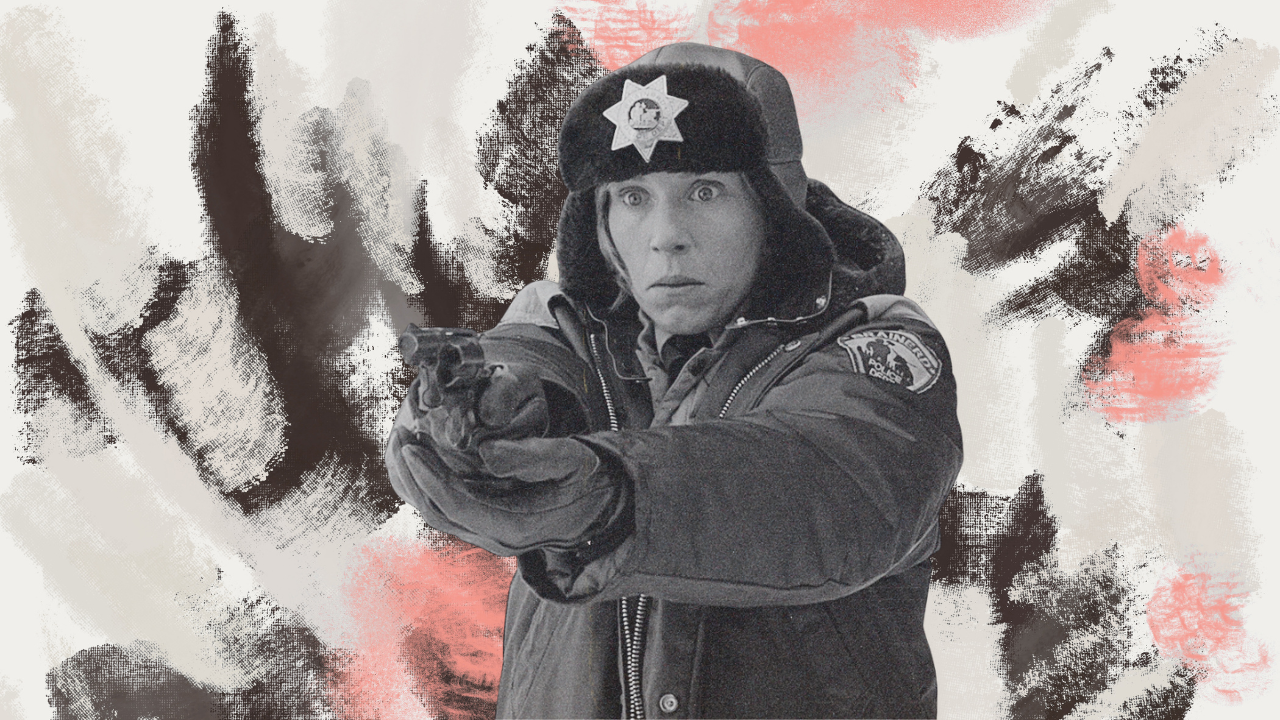
Frances McDormand‘s performance as Marge Gunderson won the Academy Award for Best Actress. And she absolutely deserved it.
Marge is seven months pregnant. She’s the chief of police in Brainerd, Minnesota. She wakes up in the middle of the night to respond to a triple homicide, and her husband Norm — gentle, devoted, a wildlife painter — gets up to make her eggs before she goes out into the cold. Marge is the person who solves the case. She does it methodically, without drama, by following evidence and asking questions and noticing when the answers don’t add up.
She is the most competent person in the movie by such a wide margin that it barely registers as remarkable until you step back and realize the film has placed a pregnant Midwestern sheriff at the center of a crime narrative and treated her authority as simply a given.
McDormand has talked about why this mattered to her. In an interview with Willem Dafoe for Bomb Magazine, she described the feminist pleasure of playing a character whose story didn’t require emotional vulnerability to be legible to the audience. Most of the roles she’d played before Fargo — even the strong ones — required her to support a male protagonist. To make herself vulnerable in service of his narrative. Marge doesn’t do that. ‘The only story I was telling was Marge’s,’ McDormand said. ‘The men in her life are defined by her.’
Marge Gunderson and the radical power of decency.
This is true in the most structural sense. Norm’s artistic career — the stamp, the painting — orbits Marge’s domestic gravity. Her professional life doesn’t bend to accommodate her pregnancy. The pregnancy is just part of her. She bends over a crime scene, straightens up, and says she thinks she’s going to be sick. And then says, ‘Well, that passed. Now I’m hungry again.’ The line gets a laugh, but what it’s actually doing is establishing that her body is not a liability or a comic prop. It’s just her body. She works through it.
There’s something almost utopian about the Gunderson marriage. Not because it’s perfect, but because both people in it are simply doing what they’re good at and taking care of what needs to be taken care of. It shouldn’t be utopia, to be clear, but here we are.
The scene at the end of the film, where Marge and Norm are in bed and Norm’s mallard has been selected for the three-cent stamp, is the most quietly radical moment in the movie. ‘It’s just a three-cent stamp,’ Norm says, modest to a fault. ‘Oh, for Pete’s sake,’ Marge says. ‘Of course they do. Whenever they raise the postage, people need the little stamps.’ And then: ‘Two more months.’ ‘Two more months.’
I’ve thought a lot about this ending for years. I think it’s the most honestly hopeful ending in the Coen brothers’ filmography, and also possibly the saddest. And the reason it can be both things at once is that Marge’s slight smile in the final shot is…unresolvable. Is she affirming the baby? Is she thinking about the wood chipper and the bodies and the fact that she’s bringing a new person into the world where Gaear Grimsrud exists? The film doesn’t answer that for you. I don’t think it can.
The banality of wood chippers.
Let’s talk about the wood chipper, because the wood chipper is the movie’s id.
Peter Stormare plays Gaear Grimsrud with a terrifying vacancy. He barely speaks. He watches television with the same absence of expression he brings to violence. When he shoots the state trooper — a scene that arrives suddenly and brutally, without any of the choreographed tension American movies usually use to signal that something terrible is about to happen — it’s shocking because of how casual it is. He does it because it was easier than the alternative. That’s all. There’s no anger, no fear, no calculation. Just the path of least resistance, which in Gaear’s world runs directly through other people.
The wood chipper appears near the end of the film. Marge arrives at the cabin where Carl hid the money and finds Gaear feeding Carl into a wood chipper with the same impassivity he brings to everything else. It’s one of the most grotesque images in American cinema of that decade. And it’s also faintly, horrifyingly funny.
Not because death is funny, of course. But because a wood chipper is a piece of lawn equipment. Because Carl Showalter, Steve Buscemi‘s motormouth hapless criminal, is being disposed of in something you rent from Home Depot. The mundanity of the instrument is the point. Evil, in Fargo, does not arrive in dramatic form. It arrives in whatever form happens to be available.
“I just don’t understand it.”
Hannah Arendt wrote about the banality of evil. The idea that the most destructive forces in history were enacted not by monsters but by ordinary bureaucrats following institutional logic. The Coens are not making a philosophical argument of that scale. But they are making a related one. That the capacity for terrible harm doesn’t have to require anything extraordinary. It requires only the absence of the capacity to think past yourself.
Put another way, Gaear kills because killing is easier than talking. Carl buries the money because greed is the only logic he has. Jerry sets everything in motion because he needs a little money and couldn’t figure out any other way to get it.
Marge’s bewilderment at the end of the film — ‘I just don’t understand it’ — is the movie’s whole argument. And she delivers it without irony.
To be clear, she’s not being naive. Marge is the smartest person in the movie. She means it as a moral statement. That the logic that produced this carnage is incomprehensible to someone who has organized her life around other values. The film doesn’t explain Jerry or Gaear or Carl. It just shows you what they built together. And then it shows you Marge and Norm in bed, two months away from the baby, and it asks you to compartmentalize.
Fargo‘s happy accident.
Roger Deakins shot the film on an Arriflex 35 BL-4 with Zeiss lenses (same as Terminator 2 and other 90s blockbuster classics). It was a warm winter in Minnesota in 1995, so most of the snow had to be artificial. The famous opening shot, the Cutlass emerging from the blizzard, was captured not by Deakins but by his assistant, dispatched to North Dakota when the weather finally turned. A fog had rolled in over the snow and erased the horizon entirely. And the assistant allegedly just went out and shot it, and that image became the film’s defining visual.
I find something almost allegorical in that production accident. The most precise and controlled of the Coen brothers’ visual strategies — the suppression of camera movement, the deliberate withholding of landscape, the white frame as moral register — and their defining image arrived completely by accident. The fog came in and ate the horizon and someone pointed a camera at it because why not.
Deakins has said that the small budget and intimate crew gave the collaboration a flexibility that the larger Hudsucker production didn’t allow. The brothers told him, in pre-production, that they wanted the exterior long shots to be done with a static camera. That meant no movement or drama, just watching. They mostly held to that. The camera in Fargo observes. It doesn’t really editorialize. It shows you the flat white expanse, the bodies in the snow, the cars on the road, with the same equanimity that Marge brings to her work. The visual style and the protagonist’s worldview are the same worldview.
The lost sheep beneath Fargo‘s violence.
Carter Burwell built the score around a Norwegian folk song about a lost sheep — ‘Den bortkomne sauen’ — transformed into a slow orchestral theme that gives the film its emotional undertow. The choice is characteristic Coen obliqueness. It’s a melody about a shepherd searching for what’s been lost, laid beneath a story about a man who can’t find his way home. Who leads everyone around him into the cold in the process. The score doesn’t underline the film’s comedy or its violence. It just persists, patient and sad, underneath both.
The television series that FX launched in 2014 is, I would argue, one of the best things that happened to Fargo as a cultural object. Not because the show is better than the film, but because it forced a reckoning with what the film actually is. The show’s creator Noah Hawley took the ‘true story’ framing and the moral architecture and the landscape and rebuilt them each season from scratch, in different decades, with different characters.
And the result was that you could suddenly see the geometry of it all. The film isn’t a story about these particular people in this particular winter. It’s a story about what happens when small human greed meets an indifferent universe. And there’s one person around who happens to believe that decency is sufficient.
Fargo‘s final argument.
Decency, in Fargo, is sufficient. That’s the argument. Decency isn’t even moral superiority or self-congratulation. It’s a daily practice. It’s making eggs for your wife before she goes out to a murder scene, caring about the three-cent stamp, being moved by the mallard painting, telling a handcuffed sociopath that there’s more to life than a little money. Marge ultimately doesn’t change anything. The dead stay dead. But she catches the men who did it, and she goes home. And the baby is coming, and it’s two more months.
30 years after the Cutlass emerged from the blizzard, Fargo is still the most honest American movie I know about the relationship between small human failure and catastrophic harm. It’s still the most precise account of what it looks like when a person can’t see past themselves. And it’s still — this is the thing I keep coming back to — warm. Sincerely warm. Because of what it believes is possible in the space between Norm’s paintings and Marge’s steady, methodical, absolutely unshowy goodness.
Happy anniversary to a masterpiece. Yah, you betcha.