Zach Cregger’s Weapons is the most disturbing movie of the year because in many ways it might actually be true.
Well, I’m not sure how exactly, but Zach Cregger managed to avoid the sophomore slump by chloroforming it, locking it in a trunk, and burying it under the floorboards of every childhood home in America. Weapons is the kind of movie that should not exist in a studio system allergic to risk. It’s Prisoners if it dropped acid and got into a knife fight with Magnolia. It’s Barbarian with its frontal lobe cracked open and its soul rearranged into a suburban ghost story soaked in trauma, terror, and some of the most disturbing schoolhouse content you’ll see this side of that Kevin guy we need to talk about. In other words, you don’t watch Weapons, you survive it.
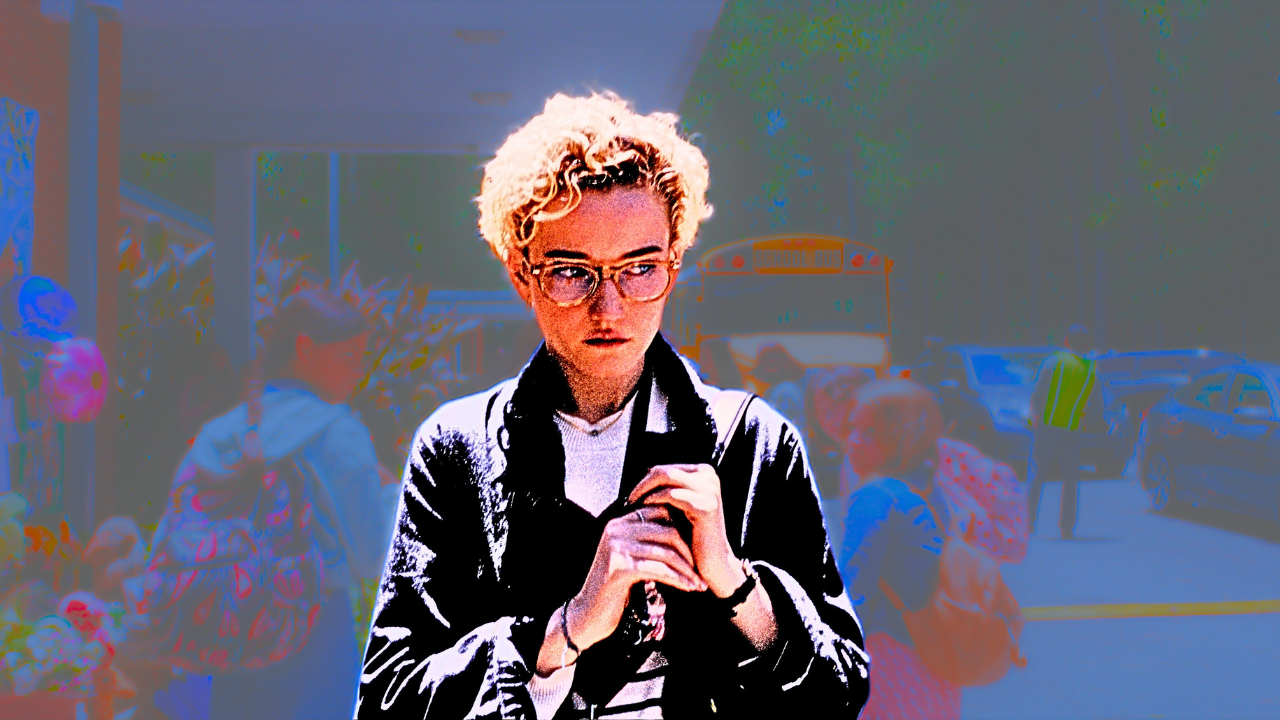
The premise is deceptively simple. At 2:17 a.m., a group of third-graders leave their beds and vanish into the night like pint-sized Slender Men looking for the Pied Piper. The only kid left behind is Alex (Cary Christopher in an eerily composed performance), a wide-eyed boy who looks like he wandered out of a Mike Flanagan project by accident. The missing class’s teacher, Justine Gandy (Julia Garner, weaponizing fragility like a scalpel), now has to contend with the fact that she only has one student left and a whole town coming after her for answers she doesn’t have.

A fever dream in six parts. None of them safe.
What follows is not a whodunit, not even close, it’s a whydowestilllivethisway. A whathavewebecome. Told in several Rashomon-style chapters, Weapons ricochets from one perspective to another with the manic energy of a filmmaker furiously rearranging the furniture in hell. That hell being our current reality. Each character isn’t so much a clue in the mystery as they are a symptom of the disease. Namely a society that would rather crucify a teacher than look inward at the systems that made this nightmare possible.
Justine, our entry point, is messy and uncomfortably so. She’s a haunted alcoholic who’s a little too invested in her students and treated like a piñata for parental rage. Garner nails the duality, both unsteady and stubborn, a woman crawling through shame and still trying to do something. Even if that means peeking into corners best left skipped over. It’s one of the most devastating, uncomfortable performances of the year and that’s a compliment. Because it weirdly asks you to withhold your empathy for her as quickly as your judgment.
Josh Brolin burns through the screen.
Enter Archer Graff (Josh Brolin), a human pressure cooker with a vengeance problem and the worst bedtime routine imaginable. If you thought Thanos had daddy issues, wait until you see Archer reviewing grainy Ring cam footage like it’s the Zapruder film, convinced Justine knows what happened to his kid. Brolin is a walking muscle spasm of grief, burning through the screen. It’s his best work since…oh, well maybe Hail, Caesar! and one of his particular f-bombs deserves a nomination on its own.

Let’s not forget Paul, the cop. Oh Paul. Alden Ehrenreich (aka the best Hollywood actor Hollywood can’t figure out what to do with until now) plays him like if Bradley Cooper’s character in A Star is Born had a badge and a flask. He’s fresh off a meltdown, emotionally constipated, and somehow still a pretty sympathetic beat cop all things considered, even for horror cinema. His chapter is a dark comedy of errors—equal parts Serpico and Reno 911!—and Ehrenreich walks the tightrope with such charm you almost forget he’s wildly unqualified for the situation at hand.
You’ll laugh, you’ll cry, you’ll regret laughing.
Cregger rounds out the ensemble with James (Austin Abrams), a twitchy addict whose eyes scream “this guy’s gonna wander into a plot twist,” and Marcus (Benedict Wong), the school principal doing an Oscar-worthy impression of “I don’t get paid enough for this.” And of course there’s Amy Madigan, whose role I’m legally obligated not to spoil but let’s just say: holy sh*t.
Tonally, Weapons is a cocktail of dread and deadpan, like if The Twilight Zone got ghostwritten by the Coen Brothers. One moment, you’re taking a breath from the carnage, the next, someone’s stabbing themselves in the face with a fork. Cregger has a knack for balancing horror and humor while also punishing you with it, weaponizing your laughter as misdirection before ripping your heart out through your tear ducts.

Barbarian cracked the door open. Weapons blows it off the hinges.
Visually, cinematographer Larkin Seiple (Everything Everywhere All at Once) shoots suburbia like the crime scene we all know it’s waiting to be, every hedge and porch light a potential altar to a Netflix true-crime doc. There’s a chase through a gas station that plays like slapstick until it doesn’t, and a dream sequence so surreal it might’ve been lifted from Silent Hill: PTA Edition. The score, co-composed by the Holladay brothers and Cregger himself, is both synth-heavy and Lynchian, but also just melodic enough to crawl under your skin without warning.
If Barbarian was about what we bury in basements, Weapons is about what we bury in ourselves. Grief, blame, a national appetite for scapegoats over solutions. The real monsters here aren’t hiding under beds, they’re sitting in PTA meetings and posting through the apocalypse. And when the final twist hits (don’t worry, no spoilers), it doesn’t explain everything. But it does reframe what “everything” means. Where the monster is everyone, and everyone happens to be armed. It’s a masterclass in weaponizing empathy, the year’s most terrifying descent into suburban hell, and one of the boldest studio films in a decade.