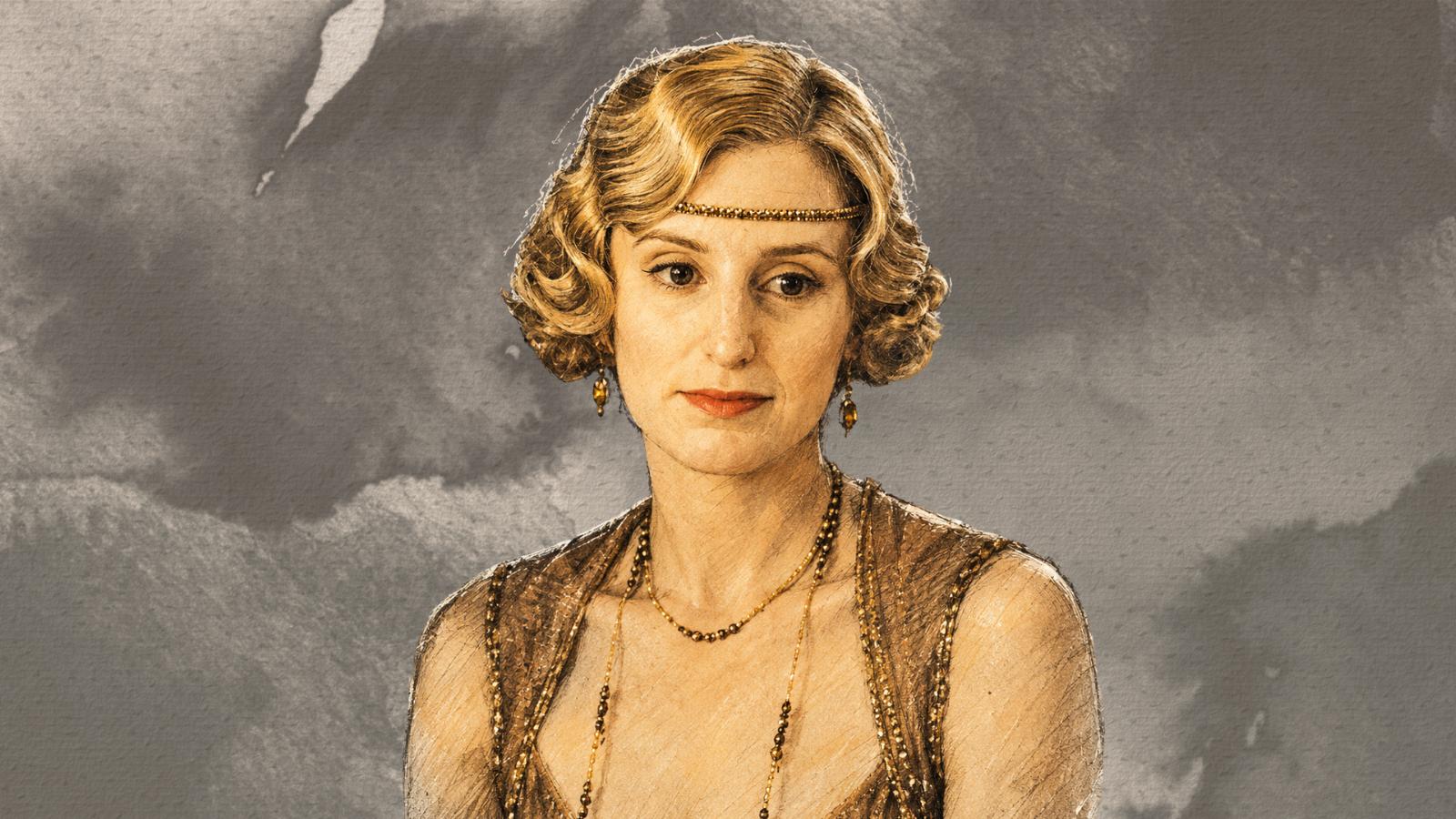
Franchise Fixations is a recurring column by Will Ashton that digs beneath the surface of today’s latest franchise films—unpacking what they add, subtract, or accidentally reveal about the ever-growing universes they inhabit. Sometimes it’s praise, sometimes it’s therapy. Always, it’s personal.
This past December, during a bustling awards season (though, I suppose, every awards season is), Bleecker Street made the curious decision. They released Fackham Hall, an appealing, zany, if undeniably slight, Downton Abbey spoof in the vein of the Zucker brothers’ parodies.
Considering that it needed to play second fiddle to Akiva Schaffer’s winning reboot, The Naked Gun, a better, more direct resurgence of the Zucker formula, Fackham Hall proved amusing enough. However, unlike Schaffer’s latest feature, which took Liam Neeson’s perpetually dire need to become an aged, traditionally serious-minded action star in the bargain-bin style of late-era Charles Bronson to its thankfully delirious, sensibly nonsensical next step, Fackham Hall never quite answers the core question it asks: why now?
Haven’t we moved on from Downton Abbey? The PBS series was an undeniable critical smash, a PBS powerhouse (if such a thing existed before outside of, say, Mr. Rogers’ Neighborhood and Sesame Street). Alas, that was another time — maybe a simpler one — when Obama was president, Trump was a reality TV host, and I’d feel no need to bring up political associations in a write-up about a show about snobby ol’ Brits!
But then I remember Downton Abbey: The Grand Finale, a feature film I saw in theaters but paid little to no mind to. Nevertheless, from the day I saw it, I felt compelled to write about it for this very reason: bemusement that this conclusive period drama was set to arrive at an off-beat era when it was truly out of time — in more ways than perhaps it ever intended.
Suffice it to say, I have an impartial relationship with Downton Abbey. But that hasn’t stopped me from writing a Franchise Fixation column before. And gosh darn it, it won’t stop me now!
To date, I haven’t seen a single episode of the acclaimed series. At this stage in life, I wouldn’t be surprised if I never watch one. (I’m more of a movie guy, as you might imagine.) But I have seen all three theatrical feature spin-offs (hey!), including the latest, presumably last, Downton Abbey: The Grand Finale, which is intended not only to conclude the trilogy but also to say adieu to the long-running series. I can’t say how it plays as a series finale. But as a trilogy capper, it’s surprisingly modest. Characters are reunited and introduced. Some loose threads are tied with elegant, pristine care. And, particularly in its sentimental conclusion, it is a heartfelt, resonant farewell, told with humor and heart, sweeping sentiments and fondly fanciful feelings.
However, maybe it’s simply the Westerner in me, or just a sign of the times. But I can’t help but see it as a brash, bittersweet goodbye—not just to PBS, the station that housed it here in the U.S., but also to the thoughtful, thematic public entertainment that came with it.
Again, I’m really sorry to bring up national politics, but it’s been on my mind a lot the past year or so. For obvious reasons, I’m sure. So, please, bear with me.
While Downton Abbey might be one of the most hoity-toity TV shows to gain a sizable audience stateside, there’s definitely something to be said about its time and place. The drama series is a product of the early 2010s. Comparatively speaking, it was a calmer, more rational time. A program about a bunch of stiff-upper-lipped men and women in faraway Britain undoubtedly evoked an even simpler, even more quaint era. But it was also a product of a world that felt on the brink of permanent progress. In America, we were living in the Obama era. Even someone like me at the time, who had an early allergic reaction to politicians, felt like things were looking up. Progress was moving forward. Things seemed to be moving; if not fully in the right direction, then at least in a direction that showed promise.
One could even say there was…hope in the air.
Then again, I was in college for most of this time. Maybe liberal arts challenged my perception of reality. Maybe I saw things from a limited perspective. Still, things looked pretty good.
Naturally, at this point in history, it’s a matter of optics. But things seemed to be far more rational and chivalrous. Obviously, many, many horrible things were going on. But it was a time when things appeared steady, secure, and secular. It’s a given, then, that a show as good-natured, thoughtful, and unprovocative as Downton Abbey was an international smash.
It is also amusing that Downton Abbey called it quits in 2015, as everything was set (or, rather, doomed) to change.
Between then and now, Brexit and the Trump administration have changed our worldview for the absolute worse. We’ve become a more polarized, provoked world. Sadly, that may not change anytime soon. And with the release of these three feature films — released in 2019, 2022, and 2025, respectively — TV lovers turned occasional moviegoers were treated to retreats not only to a simpler era on-screen, but also to characters that reflected a far more civil political climate in pop culture entertainment. Surely, it’s hard to imagine Downton Abbey finding the same notoriety — at least in the United States — that it did when it aired on television in the 2010s.
That’s not to suggest that Downton Abbey was undeserving of its acclaim and popularity. If the movies properly reflect the series, show creator Julian Fellowes brought the same high-class wit and proper posh that he previously brought to Robert Altman’s late-period triumph, Gosford Park. The lived-in warmth and camaraderie are felt even in these late-in-the-game films; one can easily imagine how they flourished over the award-winning program’s multi-season run.
The show was a hit, especially on a network as unassuming as PBS, for a reason. But timing is everything in this life. And thus, Downton Abbey had to flourish in a time and culture that was more comfortably secure and willing to embrace the high-class charm of this carryover series. In that respect, the show said its piece and left at the exact right time. The follow-up films — while enjoyably slight for what they were — largely succeed through yearning for a seemingly simpler era, for a time that the program itself could agreeably play out and appeal to the genial masses.
Unlike some other movie continuations of shows like Serenity, Twin Peaks: Fire Walk with Me, Deadwood: The Movie, or Neon Genesis Evangelion: End of Evangelion, these features aren’t designed to provide closure — reworked or otherwise — to the completed series that they’re based on. Instead, they serve as cozy escapism, like family reunions. Everyone gets together at the movie theater to see these well-to-do Brits nuzzle up together, to catch viewers up on the characters they love from the tube. By design, they’re basically gilding the lily. But in a way that is hard to be upset by. They don’t strive to be overly ambitious, especially cinematic, or even especially dramatic. In fact, Downton Abbey: The Grand Finale might be the only one with any stakes — at least to my semi-hazy recollection. The others are dainty, tasty treats in film form, and the fans were willing to gobble them up, especially in 2019.
Similar to the previous installments, Downton Abbey: The Grand Finale grossed around $100 million worldwide. But it arguably had the least pop culture impact. Anyone who cared saw it, it would seem, but there wasn’t much chatter. It said its final sentiments in a well-dignified, inoffensive way. It served as one last warm reprieve before it went away — for good this time.
Except for all its lip service about saying goodbye to the state of things, the sorrowful absence of the late Dame Maggie Smith, and the welcome, if a bit random, inclusion of Paul Giamatti this time around, Downton Abbey: The Grand Finale is fairly indistinguishable from the other entries in this film trilogy. Despite the massive lodgings of these high-society personalities, everything in these films is impressively quaint. I must marvel at a franchise that can be both this high and mighty in its posturing and minuscule in its dramatics with every installment.
Despite their characters fussing and fretting at every turn, they never suggest even the slightest bit of dramatic urgency or imply that the audience feels any unease. Things might change for these characters, especially this time around, but worry not, dear viewer. This is another day in the Downton Estate. Trials and tribulations come and go. But somehow, in one way or another, everything will work out for these grandiose, high-standing folks — no need for any concerns.
And ultimately, maybe that’s why these movies had a quiet but returning crowd. Even when the show had nothing necessary left to say of any depth or urgency, and these movies became less and less integrated into a pop culture that was swiftly and incessantly moving away from such personalities, thematically untethered to any sort of tangible reality in the year of our Lord 2025. Perhaps because this show and its spin-off films were becoming increasingly inessential in our current landscape, that is what drew some inspired interest — albeit in a warped, off-beat way.
Nostalgia isn’t about thinking about how the past was. It’s about celebrating how the past made you feel. And broadly speaking, people felt safer when Downton Abbey was on the air. Just as the show itself isn’t a proper depiction of what things were like — at least for 98.9 percent of the populace — Downton Abbey and the films were pure, calorie-free comfort food, there to provide some people with warm, wistful reminders of how they felt when everything seemed more agreeably secure. It doesn’t matter that things weren’t very good for a lot of folks in the Obama era either. There was a sense of gentle security and ease that was quite often felt.
And that is what these movies are truly about: assuring fodder. They’re like the Paddington flicks for your liberal grandma. Downton Abbey’s three films are like drinking warm tea, getting buttery danishes, and finding a way to keep the news out of mind and enjoy some calmer, safer tides. In that way, these films — modest in their aspirations — generally succeed. They don’t stick in the mind; I don’t know if I could tell you more than a couple of minor tidbits that occurred throughout this film — or any of the others, for that matter. But I remember how they made me feel, which was content, even when I had only a general understanding of the power dynamics of the characters, or only a vague recollection of what happened in the first or second films. In their old, semi-dusty, lavish but decidedly unhip way, they were ultimately about the vibes.
And the vibes, for a little while, were nice enough to make the viewer feel pleased and fine for a little while, before the lights in the theater went up and it was time to return to a world filled with constant unease, political unrest, socioeconomic strife, and generally a lot of very bad things.
That’s why, even after all these months, as Downton Abbey: The Grand Finale is now a distant, hazy memory in the back of my mind, it’s an agreeable reflection. Like half-remembered trips to see your grandparents as a kid, these movies made me feel invited and comforted, even when I didn’t know everyone, didn’t know each person’s backstory, or what was happening in this family tree. Above all, the feelings mattered most, and how fondly they were appreciated.
Downton Abbey: The Grand Finale is a pleasant, if forgettable, time. The same is generally true of Fackham Hall, despite any desire to be a bit more radical, spunky, crass, and off-kilter. Fackham Hall reminded me of the silly comedies of my youth, the sort of inspired, gag-a-minute larks that, for some reason or another, fell out of fashion around the 2000s. I missed them, and even if Fackham Hall was a fairly hit-and-miss parade of gags, it was valued nevertheless.
As both become distant memories in the spinning wheel of time and pop culture, it’s easy to see why neither made much of a dent in 2025. But different as they were, they both made things a little more bearable in a year defined by general unease. As the future grows more uncertain and taxing, it’s lovely to know past pleasures could be fleeting comforts.
Civility was nice while it lasted. That’s what Downton Abbey and its spin-off films make me think about, and I’ll miss taking that casually unremarkable feeling for comfort.