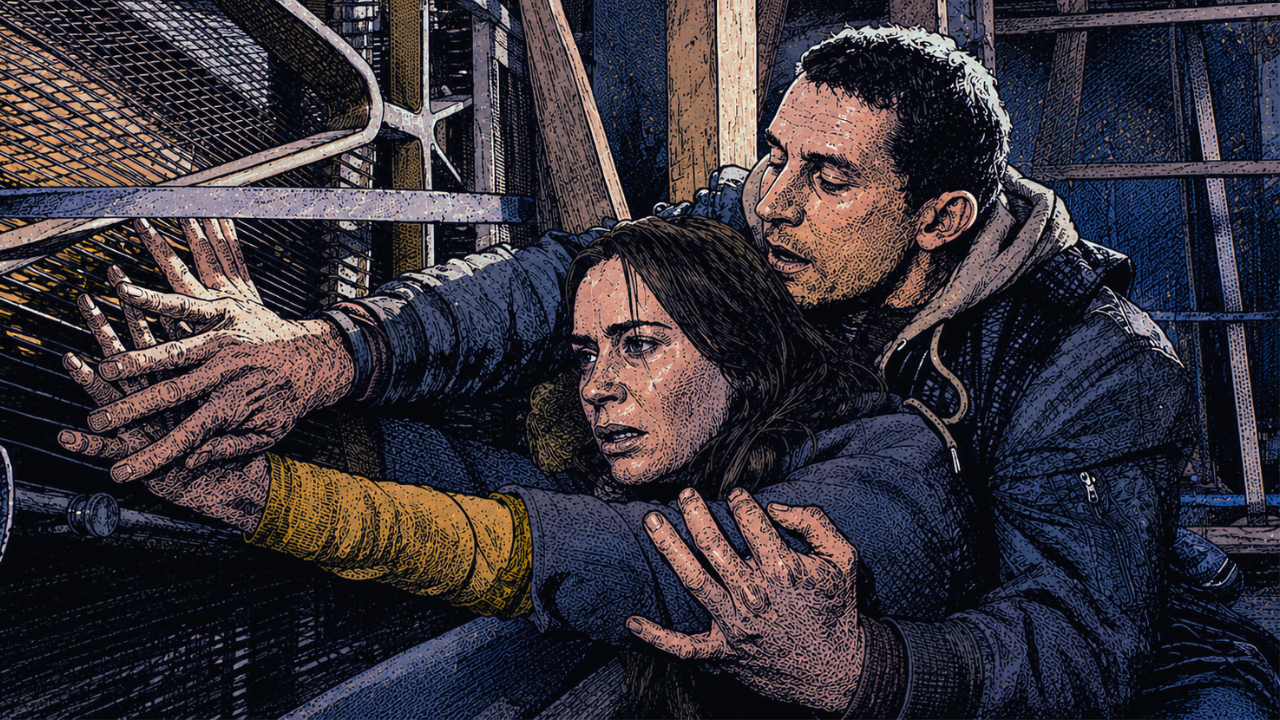
Spielberg’s 37th film, Disclosure Day, turns alien revelation into a tense, soulful thriller about the difference between faith and fear.
Margaret Fairchild (Emily Blunt) has gotten very good at smiling through a job she no longer seems to want. As a Kansas City weather anchor, she spends her mornings narrating systems that have already formed, pointing at maps, warning people about rain, trying not to look like she can feel her life narrowing in real time. Then the universe starts speaking through her. Maybe literally.
Steven Spielberg’s new film, written by David Koepp, isn’t really about whether we as a species are alone. That question has become too small for the film almost immediately. Disclosure Day is actually about what happens after the answer arrives and discovers that human civilization has no adequate language for it. The movie is a Minority Report-adjacent conspiracy thriller, yes, and often an effective one, all burner phones and dead drops and grim men in rooms saying phrases like “decision space.”
But the more interesting film underneath the thriller is about interface. Who translates the unknowable into something people can survive? Who gets to decide how much reality the public is allowed to have? And what if the truth doesn’t come as a clean revelation from the sky, but as a panic attack on a train?
That is the version of Disclosure Day that works best. The one that understands disclosure as a spiritual and neurological crisis, rather than the bare dissemination of news.
“Are they…people?”

The plot follows two people on parallel tracks. Daniel Kellner (Josh O’Connor) is a former cybercriminal turned high-level security specialist who’s stolen something from the people who paid him to protect it. He insists, repeatedly and not unreasonably, that he is “not a field guy,” which of course means the movie immediately throws him into the kind of field-guy situation where everyone has guns, nobody can be trusted, and the only person on the phone (Colman Domingo) knows much more than he’s saying. Daniel has the data. He has the proof of alien life. Daniel also has the terrible burden of knowing something the world has been denied.
Margaret has no such burden, at least not at first. She does have a boyfriend, a job, and a restless sense that she isn’t where she’s supposed to be. As well as the mildly haunted energy of someone who keeps moving cities because staying put would require answering a question she’s been avoiding for years. Then strange things begin happening all around her. She knows details about strangers she couldn’t possibly know. She understands languages she never learned. And she even freezes on live television, her supposed element, because something larger than performance has entered the room.
The film’s great structural gamble is that Daniel’s story is clean and Margaret’s is messy. His plot moves like a thriller. Hers moves like a dissociative episode out of the Alex Garland playbook. Daniel has handlers, objectives, devices, files, safe houses. Margaret has a cardinal, a traffic stop that turns uncanny, an MRI that explains nothing, and a dawning awareness that her body has become a receiver for signals she never asked to receive. On the page, this could have been chaos. Onscreen, Spielberg turns that imbalance into the movie’s beating heart.
“People are starved for the truth.”

The obvious Spielberg comparison here is Close Encounters of the Third Kind, which serves more as a sibling film than a prequel. And to be clear, Disclosure Day is far less innocent than that film and more suspicious of wonder. Here, awe appears after decades of institutional abuse, defense contracting, secrecy, and ridicule. They hid the unknown, yes, but also classified, monetized, and weaponized it. Then socially shamed it out of acceptable conversation. That turns out to be the movie’s sharpest accusation. The villains of Disclosure Day taught the world to distrust astonishment.
That idea gives the film a surprising moral charge. Wardex, the shadowy organization at the center of the conspiracy headed up by the film’s main body-snatcher-villain (Colin Firth), believes it’s protecting civilization from the truth. Its argument is chilling because it is not entirely stupid. Religious systems might rupture. Governments might collapse. A world already flirting with nuclear catastrophe might not need one more impossible thing dropped onto its chest without warning.
The archive Daniel wants to release is described at one point as a virus against which the world has no immunity. That’s exactly the sort of metaphor powerful people use when they’ve mistaken their own control for public health. So Daniel’s counterargument is simpler and, ultimately, more persuasive. Reality doesn’t and shouldn’t belong to the people who found a way to profit from hiding it.
Still, the film is smart enough not to let him off too easily. He’s heroic but also unilateral. The question hanging over Disclosure Day is not whether people deserve the truth. They do. The question is whether anyone gets to decide the manner and timing of a revelation that will reorder every story humans tell about themselves. Daniel thinks truth in and of itself is enough. The film knows truth needs an outlet in order to be enough.
“If you do this, there’s no undoing it.”

That is where Margaret comes in. Her gift, if that is even the right word, is empathy pushed past the point of comfort. She receives personhood just by looking at someone. She can fall into them for a few seconds and take on their grief, pain, memories, the thing they said to their wife that morning, the old wound in their shoulder, the private terror they thought nobody saw.
This all plays more as an invasion than a bonafide superpower. Spielberg has always understood that the extraordinary registers most powerfully when it interrupts the ordinary mid-sentence. And some of the film’s best sequences come from watching Margaret try to remain a normal person in normal spaces while the universe keeps making her a sage with strangers.
This is also where Disclosure Day becomes more than a “what if aliens are real?” movie. Daniel can understand the hidden archive. Margaret can understand people. He is math, code, systems, evidence. She is language, memory, feeling, witness. Each is incomplete without the other. Knowledge without empathy becomes yet another weapon. But empathy without knowledge becomes unbearable. Together, they represent the film’s most hopeful idea. The one that connects most fiercely to Close Encounters. That disclosure requires translation.
That is why Margaret’s job matters so much. Making her a weather anchor is more than just a cute local-news flourish. Weather is invisible systems becoming visible consequence. Pressure, temperature, vapor, fronts. Forces moving beyond our sight until suddenly the sky explains them for us. Margaret’s life has been spent narrating the arrival of things already on their way. By the time the film reveals what it has been building toward, her profession feels like destiny hiding in plain sight. She’s always been forecasting. So she’s perfectly suited to herald this storm.
“When the time is right, everything will become clear.”

Spielberg and Koepp are especially good at threading that cosmic material through domestic spaces. Margaret’s awakening ironically begins with a bird, window, and boyfriend (Wyatt Russell) who thinks she might need medical help. A job where being even slightly off-script can feel like public death. The uncanny lives in traffic stops, station hallways, exam rooms, motel lots. And that choice keeps the movie human-sized even when the stakes turn planetary.
The weakest but still fascinating piece of the film is Jane (Eve Hewson), Daniel’s partner and the character asked to carry much of the religious anxiety. Her past as a former novitiate gives Disclosure Day one of its richest thematic veins. It avoids the tired question of whether extraterrestrial life disproves God and settles more on the frightening question of whether humanity’s inherited stories are elastic enough to survive enlargement. Jane’s fear has less to do with God and more to do with people. That humans can’t be handed a bigger universe without making themselves smaller in response.
It’s a fine idea, but the film doesn’t always give it enough room to breathe. Jane is often more moral interlocutor than fully weighted emotional center. And there are moments when the theological subtext walks into the dialogue wearing a name tag. But when the movie gets her right, it gets her very right. Her crisis could’ve easily been yet another faith-in-God crisis, and in some ways it still is. You can see Spielberg’s own grappling with the nuances between the Jewish faith of his upbringing and the Christian institutions that defined the world around him as a young filmmaker.
So in that way, it’s easy to see why Disclosure Day, much like Close Encounters, is so deeply interested in belief. As well as the social conditions that make belief survivable.
“Why would they do this?”

The finale, which I will discuss only in broad terms, is the movie’s masterstroke. A lesser modern thriller would resolve this story with an upload bar. Daniel would push the archive to the internet, mirrors would proliferate, and someone would say something grim about how they can never put the genie back in the bottle or something. Disclosure Day has better plans. It understands that the internet is too diffuse, too deniable, too polluted by the fake-real blur that now greets every image of consequence. So Spielberg routes revelation through a much older civic ritual. Live television. Worse, local news.
The climactic sequence builds out of affiliate feeds, playback channels, control-room panic, people asking whether New York can see this, anchors trying to maintain composure as history comes through the monitors. So it’s far from the spectacle sequence we’d recognize in the usual sense. It’s bureaucracy losing a footrace with wonder. And that’s precisely what makes it so effective. Most films of this kind would ask us to feel the scale through explosions and skies full of ships. While Spielberg asks us to feel it through professionals realizing, in real time, that the format they’ve devoted their lives to has become too small for the thing it now has to transmit.
There’s something almost movingly old-fashioned about that choice. Disclosure Day revels in the shared public event. It believes there’s still power in countless people watching the same thing at once and understanding, however imperfectly, that the world has tilted. In an era when every revelation is instantly chopped into clips, counterclaims, memes, debunks, and monetized disbelief, Spielberg stages disclosure as something beyond content and discourse. It’s a turning point one can’t help but witness in utter silence.
“This is Disclosure Day.”

That may be the film’s most Spielbergian quality, and also its most melancholy. Earlier Spielberg alien movies asked what might happen if ordinary people looked up and found wonder. Disclosure Day asks what happens if wonder has to pass through militarization, surveillance, trauma, religious dread, and institutional rot before it reaches us.
The child sees the light and reaches for it. The adult sees the light and follows the money: who classified it, who patented it, who laughed at the first witness, and who built a career keeping the rest of us in the dark.
And yet the movie isn’t even cynical. And that’s important. Yes, fear runs through it, sometimes brutally so, but it is not cynical. Its deepest villain turns out to be epistemic despair. The belief that people cannot know reality and remain human. The belief that humans are too fragile, too tribal, too stupid, too religious, too online, too incompetent for truth. Disclosure Day knows full well that truth can and often will injure. But it also argues that enforced unreality injures even more.
The bottom line.

The film has its many flaws, of course. It occasionally over-explains what its images have already told us. Its conspiracy machinery can get dense in the way Koepp scripts sometimes do when they’re having too much fun with procedural nouns. Some of the supporting players feel like they were designed to embody arguments the movie needs rather than lives it has fully imagined. And depending on your tolerance for late-Spielberg earnestness, the final emotional gesture may either knock the air out of you or make you reach for the nearest smartphone.
But when Disclosure Day works, it works as both a thriller and a plea to the heavens for our ability to withstand the onslaught of the future. It’s about aliens, sure, but that is almost the least interesting thing about it. It’s about the terror of being believed after years of being trained to feel foolish for what you believe. Remarkably, it’s about faith systems that may need to grow rather than break. And about local news anchors, frightened lovers, rogue technicians, old secrets, and the impossible burden of telling the truth at exactly the wrong time because there may never be a right one.
The final grace note of Disclosure Day is a simple one. Humanity is not alone in the universe. And, more importantly, the lonely, the frightened, the mocked, the overwhelmed, and the half-broken are not alone, either. That is a very Spielbergian thing to believe, no matter the era.
Disclosure Day opens in theaters on June 12. Watch the trailer here.
Images courtesy of Universal.