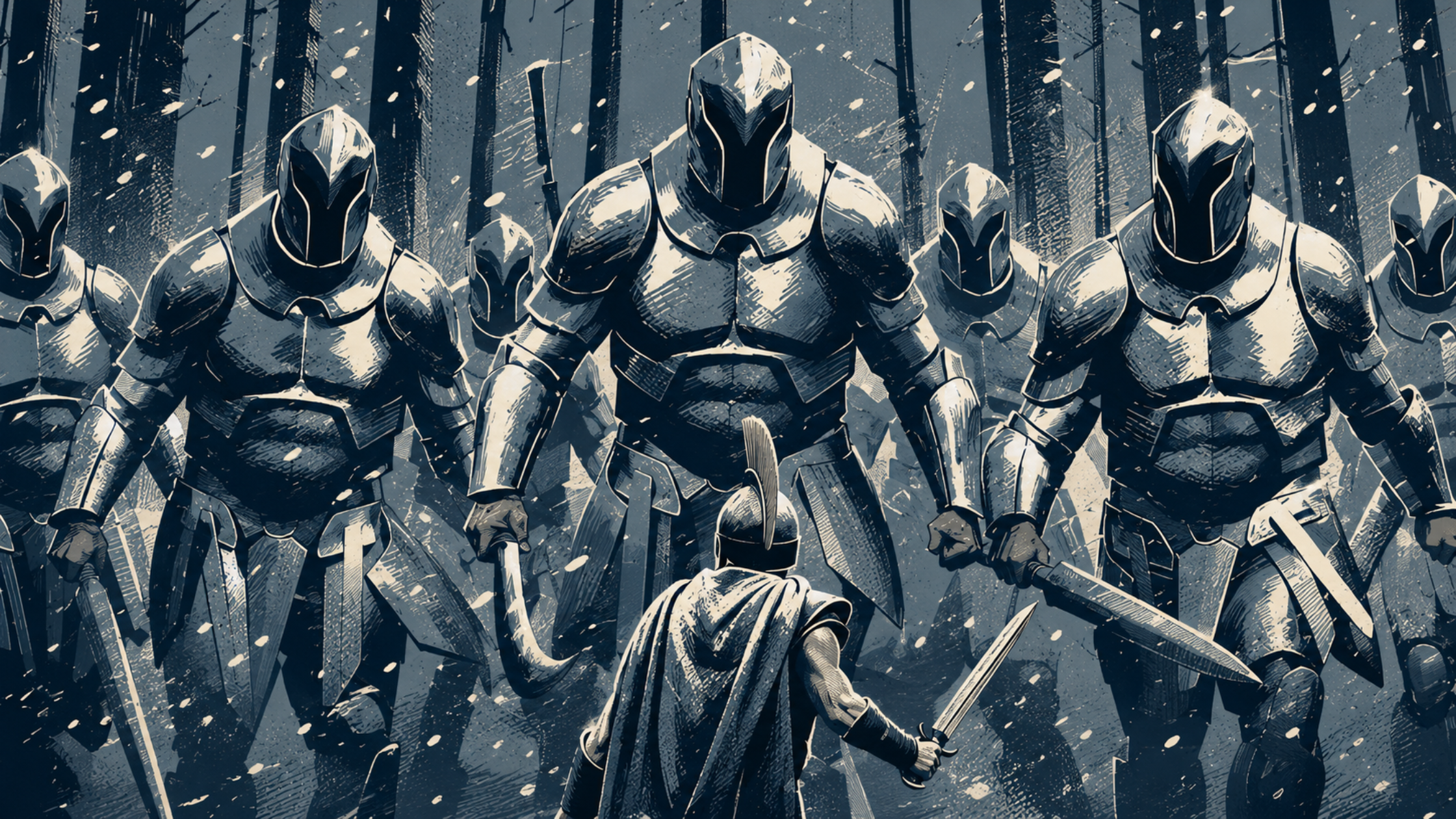
Christopher Nolan’s mythic epic turns Odysseus into the architect of a collapsing world, though its towering ideas are frequently tangled in exposition and unwashed sentiment.
Christopher Nolan has spent much of his career making movies about men who invent ingenious solutions to immediate problems and then spend the remaining runtime staring into the abyss those solutions opened. Robert Angier creates the perfect magic trick and loses the distinction between performance and self-annihilation. Cobb builds dreams inside dreams until his own memories become hostile architecture. J. Robert Oppenheimer helps end one war and glimpses the possibility that he has placed every future war on a countdown.
So in that sense, Odysseus may be Nolan’s most inevitable protagonist yet. Here is a man whose cleverest idea wins the Trojan War by teaching civilization that every sacred custom can be converted into a weapon. An offering can conceal soldiers. Hospitality can create vulnerability. Trust can become the unlocked door through which an enemy army enters. Victory belongs to whoever spots the loophole first.
That is the fascinating, frequently overwhelming idea at the heart of The Odyssey, Nolan’s enormous, salt-crusted adaptation of Homer’s timeless epic. The film treats the Trojan Horse as something closer to the ancient world’s atomic bomb: a brilliant innovation that resolves a conflict while poisoning the moral ecosystem around it. Odysseus wins the war, sails home, and discovers that his trick has escaped containment. The bonds between hosts and guests, rulers and subjects, soldiers and commanders have begun snapping all across the Mediterranean.
The movie around that idea resembles one of its own storms. It is thunderous, beautiful, disorienting, and prone to throwing entire ships’ worth of names, prophecies, betrayals, political anxieties, and mythological detours directly overboard. Nolan lashes the audience to the mast and assumes we can read the map while seawater fills our eyes.
At its best, The Odyssey finds a genuinely fresh angle on one of the oldest surviving stories in Western literature. At its weakest, every character sounds ready to defend a doctoral thesis on the Bronze Age collapse. The gods speak in omens. The humans speak in declarations. Ludwig Göransson’s score pounds the subtext into the seabed in case anyone missed it on the way down.
Still, the film’s ambition has real undertow. Nolan is reaching beyond a hero’s return home toward a larger question: what happens when the man who saved civilization becomes the man who taught everyone how to destroy it?
(Warning: the rest of this review contains spoilers and plot details. It is meant to be read only after watching the film)
“The war is over.”
The movie begins where many versions of the story would place their climax: Troy falls. Nolan gives the Trojan Horse the requisite scale, fire, and screaming hordes, but the important detail is its status as a gift. The Greeks do more than smuggle troops behind Troy’s walls. They disguise an act of war as a sacred offering, exploiting the very customs that allow strangers, pilgrims, and emissaries to move through the world without immediately catching a spear through the ribs.
In other words, Odysseus invents a way to turn belief against the believer. And yes, the consequences ripple through the rest of the film. Every subsequent encounter becomes a test of whether the old rules still carry meaning. Odysseus and his men enter unfamiliar homes expecting food because Zeus supposedly protects guests. Hosts demand that travelers surrender their weapons because hospitality supposedly protects them in return. Sailors ask for shelter. Islanders assess whether the men arriving from the sea are refugees, raiders, soldiers, or some especially hungry combination of all three.
The point is that nobody can tell anymore. And that confusion also consumes Ithaca, Oydsseus’s home, where his wife Penelope has spent nearly two decades holding a kingdom together through the increasingly theoretical power of manners. The suitors eat Odysseus’s livestock, corrupt his servants, occupy his hall, and pressure his wife toward remarriage. They perform the outward role of guests while hollowing the household from within.
Their behavior directly mirrors the Trojan Horse. They enter under the shelter of a social custom and use that custom to dismantle the people protecting it. Nolan’s most compelling move is to make this the link between Troy and Ithaca and of course our own modern world where political “norms” no longer protect institutions like democracy and limited government. Even if Odysseus can make it home, he will face punishment for his own great trick. He’ll return to discover opportunists using his invention against his family.
“A kingdom waiting for a king.”
The familiar misconception about The Odyssey is that Penelope spends the entire story sitting by a window while her husband enjoys the world’s most eventful detour. Anne Hathaway’s Penelope puts that interpretation to the sword. She’s the film’s clearest political thinker because she understands that Odysseus’s prolonged absence has created two separate crises. The first concerns her family. The second concerns Ithaca’s survival as a state.
Rumors have begun spreading about mysterious “people from the sea” attacking settlements and disrupting trade. The elders want a king who can raise an army. Telemachus (Tom Holland) remains too young, too untested, and too visibly desperate to inherit his father’s authority. The suitors’ presence is grotesque, though their central argument carries an uncomfortable degree of sense: a kingdom cannot spend forever waiting for a dead man to sail over the horizon.
Penelope’s position exposes the absurdity underneath Ithaca’s customs. On her own, she’s managed the palace, protected the estate, negotiated with rival families, preserved Odysseus’s lineage, and kept the kingdom from fully collapsing for twenty years. Everyone nevertheless speaks of an “empty throne” because the person effectively ruling the island lacks the “correct” gender for anyone to call it rule.
Hathaway gives Penelope a grave, sharpened patience. Her patience is  labor. Every soft reply involves a calculation. Every apparent concession buys another night. Her famous weaving scheme becomes less a quaint display of marital devotion than a filibuster conducted with thread.
The film occasionally hands her dialogue that belongs engraved on a courthouse wall. Yet its larger insight holds firm: Ithaca survives because Penelope keeps behaving as though its laws remain real, even as every man around her treats those laws as props.
Robert Pattinson’s Antinous understands that weakness perfectly. His principal suitor is a silky piece of work, part concerned statesman, part home invader who’s begun complimenting the drapes. He speaks about Penelope’s exhaustion, the kingdom’s exposure, and her right to resume living. Each point sounds almost humane until it becomes clear that his preferred future places him in her bed and on her throne.
Put another way, Pattinson plays Antinous as Odysseus without the legend: another clever man who studies a system until he discovers how to make its rules serve him.
“What do you know about my father?”
While Penelope fights a cold war at home, Telemachus goes looking for the man everyone else already turned into a song.
Tom Holland’s Telemachus initially has all the aggrieved energy of a prince who’s spent his life being told that adulthood will begin as soon as his father stops occupying every room through sheer absence. He wants authority, answers, and enough facial hair to stop being called a boy. Mostly, he wants someone to explain why the greatest strategist in Greek history cannot locate a fairly prominent island.
His journey through the remnants of the war gives the film its richest structural counterpoint. Telemachus assembles Odysseus from other people’s memories at the same time Odysseus begins recovering memories he has buried.
Menelaus (Jon Bernthal) remembers the brilliant tactician who cracked Troy. Soldiers remember the commander whose plans required somebody else to die. Bards remember the horse. Widows remember what came out of it. Every testimony adds another Odysseus without resolving the contradictions among them.
That is the movie’s more sophisticated idea about mythmaking. A legend is less a lie than a form of editing. The songs preserve the trick, the victory, and the glorious name. They trim away the logistics of slaughter, the discarded bodies, and the frightened men who had to believe whatever their commander told them.
Telemachus begins the film asking whether his father lives. He gradually arrives at a thornier question: what kind of man would come back? And Holland captures that shift well, particularly as boyish worship hardens into wary curiosity. The performance works best when Telemachus stops announcing his maturity and begins listening. Nolan has always loved stories about fathers whose supposedly noble missions leave their children managing the emotional wreckage. Here he finally makes the child travel directly into the myth and inspect the damage for himself.
“Tell me what you remember.”
We learn early in the film that Odysseus, meanwhile, has spent much of his time away with Calypso (Charlize Theron) in a lotus-assisted fog. This is perhaps the film’s largest departure from Homer and perhaps its shrewdest psychological conceit. In the poem, Odysseus retains his memories and openly longs for Ithaca. Nolan’s Odysseus has allowed his identity to dissolve. Calypso saves his body after the loss of his crew, then uses the lotus flower to cushion his mind from everything that body survived.
Matt Damon plays this early state with a strangely touching vacancy. His Odysseus knows that something lies beyond the beach, though every attempt to reach it comes as an image without context: fire on stone, the curve of a bow, a child’s face, a woman whose name catches somewhere behind his teeth.
Calypso offers him the softest prison in the film. She provides safety, affection, food, and the possibility of living forever inside an edited self. Charlize Theron brings real ache to the character’s rationalizations. She restored him. Loved him. She also kept feeding him the thing that prevented him from meaningfully choosing whether to stay.
Their relationship becomes the movie’s most literal expression of memory as both wound and compass. Odysseus’s recovered identity hurts because pain forms part of the identity. Calypso can remove the guilt only by removing the man who feels it.
Once those memories return, the movie dives backward into the famous voyage: Polyphemus, Circe, Hades, the Sirens, Scylla and Charybdis, the cattle of the sun god. Nolan paces these episodes like a sequence of increasingly disastrous command decisions rather than a mythological travelogue.
Each new island presents Odysseus with a problem. Each problem invites a clever solution. And each solution creates a larger debt. His mind remains the sharpest weapon in the movie, and like every weapon, it eventually starts looking for reasons to stay drawn.
“The gods help those who help themselves.”
The Cyclops sequence provides the film’s clearest example of Nolan’s approach to mythology. The creature remains monstrous, yet the scene plays through weight, distance, rope, fire, blocked exits, and the terrible, brutal math of how many men must die to create an opening for the rest.
The spectacle is immense. The thinking is granular. Odysseus excels in this environment because terror simplifies the moral field. There is a cave, a monster, and a crew that requires extraction. Every choice can be measured by whether it gets someone through the mouth of that cave.
Trouble arrives once survival gives way to pride. Odysseus cannot simply escape. He needs the monster to know who beat it. His intelligence earns the victory; his ego sends the invoice to everybody else. From that point onward, the voyage gradually becomes a mutiny against the idea that Odysseus always knows best.
Circe forces him to confront what years of war have done to his men. Her transformation of the sailors into pigs lands with the force of a metaphor Nolan has decided to make extremely, unmistakably literal. She sees raiders, looters, and hungry veterans claiming the protection of Zeus whenever they need a meal. Odysseus sees exhausted soldiers who want to return to their families.
Both perspectives carry truth. The movie occasionally stacks the deck by making Circe sound like a modern war-crimes tribunal wearing simple robes, but the confrontation punctures the comfortable assumption that homeward direction makes the men innocent travelers. Even though they’re already becoming the feared people from the sea.
“The dead remember.”
The voyage into Hades supplies the movie’s moral center and several of its most frustrating tendencies. Nolan stages the underworld as a place where heroic editing loses its power. The dead possess no use for reputation. They remember who was abandoned, who received burial, who died believing a commander’s lie, and whose name survived because somebody else’s vanished.
Odysseus enters looking for directions and finds an audit. One fallen soldier (Elliot Page) confronts him over a deception that helped make the Trojan Horse possible. Odysseus argues, in essence, that the lie worked. The soldier asks what consolation efficacy provides to a man who died inside it.
That exchange unlocks the movie. Odysseus has built his entire moral life around outcomes. He believes the result retroactively sanctifies the method. Troy fell, therefore the Horse was justified. Men survived the cave, therefore the sacrifice was worthwhile. The ship escaped the whirlpool, therefore concealing the danger made sense.
The dead measure differently. They care about what a person was asked to believe at the moment his life became expendable. Agamemnon’s shade also turns the idea of a homecoming into a warning. Betrayed by his lover, the famed warrior learned the hard way that a returning king should probably avoid the front door. Odysseus absorbs the tactical lesson of Agamemnon’s death immediately, but he’s more selective about the emotional aspect of that lesson. Because to Odysseus, suspicion fits far more comfortably inside his skill set than trust.
The entire sequence contains some of the movie’s strongest material, alongside dialogue that explains that material until the ideas begin walking around with little bronze name tags. Nolan rarely encounters a theme he cannot make three characters define aloud. Here the habit becomes especially cloying because the dead frequently speak like visiting lecturers granted one final office hour.
Even so, the conception carries enormous power. Hades is the one place where Odysseus can no longer control the story because everyone already knows how theirs ended.
“I want to hear the song.”
The Sirens reveal what Odysseus has kept hidden even from himself: some part of him prefers the journey. Some part of him wants this adventure. He insists on hearing their song because nobody else has ever heard it and survived. That reasoning essentially sums up his entire pathology. He calls the danger worthwhile because becoming the first man to return with the knowledge would make the danger his.
The film’s Siren song offers each listener some combination of deepest desire and deepest dread. For Odysseus, it suggests that home functions as an alibi. He says he wants Ithaca while repeatedly choosing the next horizon, the next puzzle, the next situation in which his mind becomes indispensable.
A king at home must share power with a wife who learned to rule without him and a son who grew into a stranger. A captain at sea needs only to issue the next command. This gives the movie’s title a new edge. The odyssey is a punishment, certainly, but it is also the environment Odysseus understands the most. He knows how to survive monsters. Breakfast with his family presents a more exotic challenge.
That idea comes through beautifully. Then the screenplay explains it, restates it, gives the Sirens a chance to sing it, and all but asks the audience to sign a parchment confirming receipt.
“You knew?”
The Scylla and Charybdis sequence crystallizes the tragic limit of Odysseus’s genius. He’s been told that a sacrifice must occur. He interprets prophecy as a puzzle designed to reward a sufficiently intelligent workaround. When the route demands lives, he withholds the truth from his crew because informed men might refuse to follow.
So he saves most of them. But he betrays all of them. The aftermath matters more than the monster. Odysseus defends his choice through the mathematics of survival. The crew responds through the language of consent. He possesses responsibility for the decision, though he behaves as though responsibility also grants ownership over everyone’s knowledge.
This dynamic continues on the island of the sun god. The men starve while sacred cattle graze within reach. Odysseus gives them orders and warnings not to eat the cattle, lest they lose their lives. The gods give them hunger and take the calm weather that would let them leave shore. Eventually the crew decides that drowning after a meal beats starving in obedience.
Their doom carries divine consequence, though the film refuses to frame it as simple foolishness. By then, trust aboard the ship has already collapsed. The sailors know Odysseus possesses information he’s repeatedly withheld. Even an accurate warning begins sounding like another command backed by a secret calculation.
“It’s not always an easy thing, a homecoming.”
Once Odysseus reaches Ithaca, The Odyssey shifts from elemental adventure into something like an ancient home-invasion thriller, except the invader owns the house.
The disguise as a beggar gives Damon his best stretch of the film. Odysseus can finally observe the consequences of his absence without enjoying the protection of his name. He sees servants humiliated, his dog neglected, his son hunted, his wife cornered, and his hall turned into a banquet financed by his own disappearance.
He also sees how eagerly everyone receives stories about him. Odysseus has become Ithaca’s favorite genre. The disguise works on another level because Odysseus remains unsure which version of himself deserves to return. The warrior king might command the room, but the beggar can move freely inside it. During his conversations with Penelope, he describes Troy from the perspective the songs omit: fire, panic, desecration, and a brilliant idea transforming into historical catastrophe.
Penelope begins recognizing him through his shame, which is one of Nolan’s most elegant revisions. Physical appearance can be imitated. Tokens can be stolen. Stories can be rehearsed. The guilt belongs to the man who carried it home.
Their scenes together also reveal the cruel asymmetry of the entire journey. Odysseus has been transformed by experience, enchanted by goddesses, stranded among monsters, and relieved of his memories. Penelope has experienced transformation through stasis. She remained in the same place and watched everything around that place change. Mostly for the worse.
He endured the world. She endured waiting for him to finish enduring it.
“Show me who you are.”
The bow contest at the climax is the convergence of every major idea in the film: identity, performance, hospitality, strategy, and the weaponization of ceremony. Penelope announces a marriage trial. The suitors gather for a civic ritual. Weapons quietly disappear from the hall. Doors close. The beggar waits for his turn.
The entire setup mirrors the Trojan Horse. Once again, people accept a ritual object into a protected space. Once again, Odysseus hides in plain sight. And once again, the apparent ceremony becomes an ambush. Cleverness turns trust into a killing ground.
Nolan stages the violence with weight and confusion. The hall becomes cramped, smoky, and difficult to read. That choice suits the action emotionally, though it also contributes to the movie’s larger intelligibility problem. Between Göransson’s roaring score, the clatter of bronze, thick accents, mythological names, and Nolan’s continuing fondness for dialogue delivered as though audible speech were a bourgeois indulgence, several crucial exchanges become offerings to the subtitle gods.
The massacre also denies Odysseus a clean restoration. Killing the suitors creates widows, fathers, brothers, and another generation of men obligated to demand blood. Penelope understands this before anyone draws the first arrow. Telemachus understands that inheriting the throne may now mean inheriting exile. Odysseus knows the pattern and follows it anyway.
“The people from the sea.”
The film’s most provocative historical invention links the wandering Greeks with the mysterious raiders later remembered as the Sea Peoples, turning Odysseus’s voyage into an origin story for the Late Bronze Age collapse.
The idea works far better as myth than history. Nolan compresses a sprawling, contested transformation involving trade disruptions, palace instability, migration, warfare, famine, and systemic fragility into the moral wake of Troy. Odysseus’s Horse becomes the stone that knocks over every palace from Anatolia to Ithaca.
That is a lot to place on one clever wooden animal. Still, the simplification serves the movie’s tragic underpinnings. The Greeks return from war carrying the habits that made them victorious. Soldiers unable to find food become raiders. Raiders become stories about invaders. Trade routes collapse. Kingdoms arm themselves. Hospitality erodes. Writing disappears. The interconnected world destroys itself because every participant has learned to treat cooperation as exposure.
Odysseus eventually realizes that the mysterious civilization-ending men from the sea are men like him. That revelation gives the spectacle an unusual melancholy. The enormous landscapes and ships convey a world stretching toward infinity, while the story keeps reminding us that this entire network of palaces, customs, routes, songs, and writing systems is about to go dark. So that means history will remember Odysseus because history forgets nearly everyone else. Fitting, no?
The bottom line.
The Odyssey is a fascinating, unwieldy film, capable of producing a breathtaking image and then sending three characters to stand beneath it and explain what it represents.
The all-IMAX photography gives the ocean a frightening verticality. Waves rise like skyscrapers. Cliffs seem to possess judgment. Human beings shrink to the size of ideas the gods might abandon halfway through thinking. Göransson’s score supplies thunder even on clear days, sometimes thrillingly and sometimes with the emotional subtlety of Poseidon dropping a piano onto the deck.
Damon gives the film its battered center. His Odysseus has the posture of a man who can still command a crew and the eyes of one who’s begun suspecting the crew was right to hate him. Hathaway supplies the moral clarity. Holland gives the legend a human consequence. Pattinson has tremendous fun slowly removing the velvet glove from Antinous’s entitlement.
The movie’s flaws remain considerable. Its chronology can become punishingly difficult to track, especially as memories, divine visions, recovered stories, and parallel journeys bleed together. Supporting characters vanish for long stretches and later return carrying emotional weight the film has barely preserved. Several performances get stranded inside exposition, particularly Zendaya’s Athena. And Nolan’s earnestness repeatedly swells into something close to self-parody, with characters speaking in solemn aphorisms while the score practically kneels beside them.
The film is also a bit too eager to connect Odysseus with the fall of an entire civilization that its insight occasionally balloons into grandiosity. The Trojan Horse becomes original sin, the Sea Peoples become displaced Homeric veterans, and one man’s inability to distinguish cunning from wisdom becomes an explanation for centuries of darkness.
Yet the reach itself remains compelling. Nolan sees in Homer a story about the dangerous afterlife of innovation: the trick that works so well everyone learns it, the war won by techniques that make peace impossible, the hero who returns to discover that his greatest talent has become the culture’s terminal disease.
Most adaptations ask whether Odysseus can survive long enough to get home. Nolan asks whether home can survive what Odysseus learned on the way. And the answer is tangled, thunderous, and occasionally syrupy enough to make the lotus flowers taste tart. It also sticks. For all its narrative fog, The Odyssey understands that monsters make the easiest part of any voyage. The harder task comes after the beast falls, when someone has to explain the bodies, rebuild the house, and decide which version of the story will survive.
Odysseus reaches the shore. Nolan spends nearly three hours wondering whether his arrival deserves to count as a return at all.