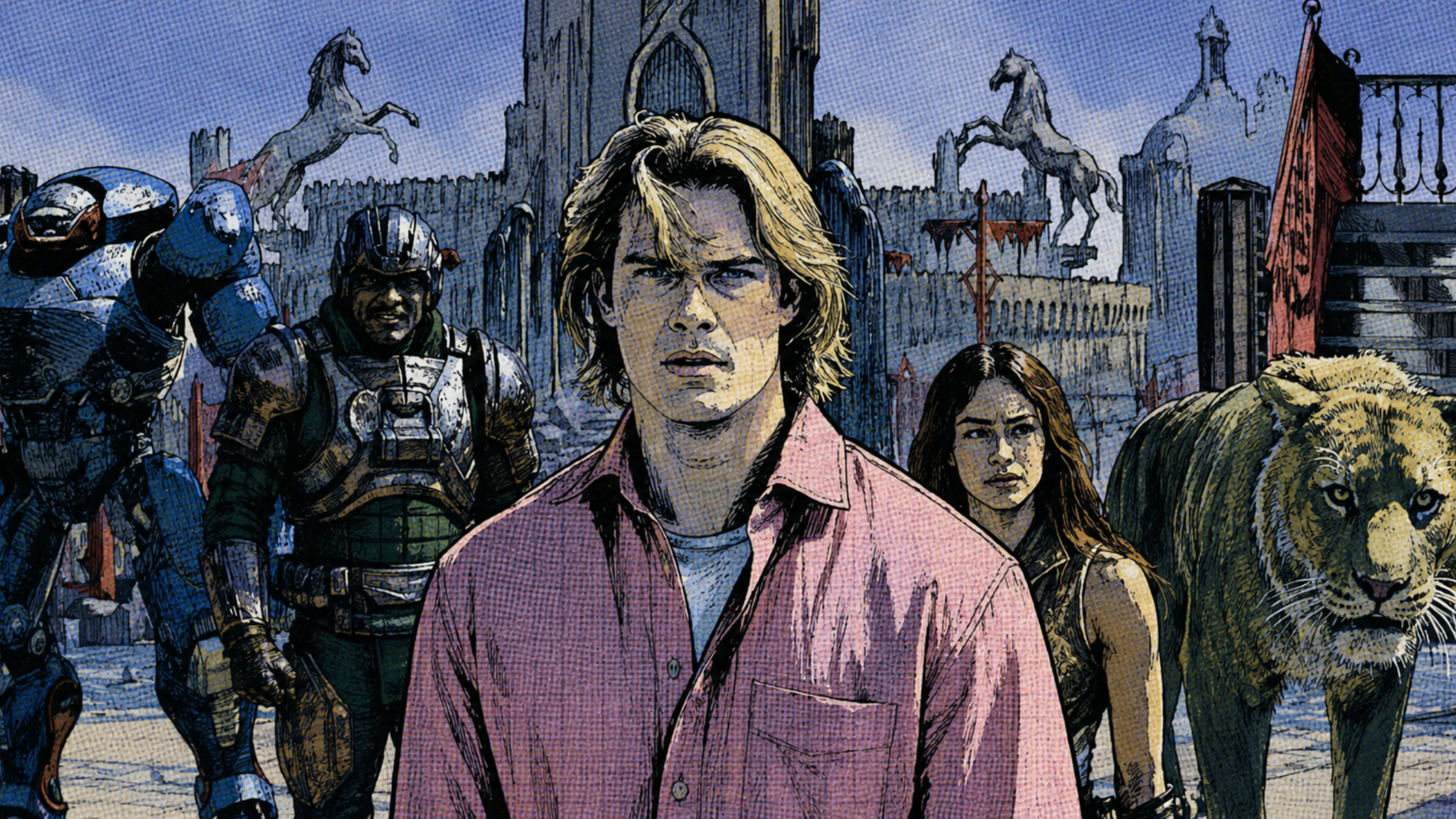
Directed by Travis Knight, Masters of the Universe (2026) turns He-Man into HR-Man, burying a half-decent concept in 20teens blockbuster BS.
Somewhere around the fortieth minute of Masters of the Universe (2026), Prince Adam — sole heir to a murdered king, last hope of a conquered planet, the most powerful man in the universe — sits a cybernetic warlord down for a chat and walks him through conflict de-escalation. He learned the technique at his Earth job. In human resources. He calls it “resolution through unaffected communication,” and he means it. And the movie wants me to find this…delightful? Funny? Well, I sat in the dark and felt a familiar dread settle over me, instead. The dread of a film that has located its own beating heart and totally forgotten that it also needs a brain.
Let me back up, because the backstory matters more than usual here. Mattel built Masters of the Universe in 1982 as a toy line. And the cartoon followed to move plastic off shelves, which means the property arrived pre-loaded with a tension every adaptation since has wrestled with. Because it sells the sincere mythology of a man lifting a sword and shouting at the sky, and it sells it as merchandise.
The 1987 Dolph Lundgren film leaned cheap and earnest and flopped. Kevin Smith’s recent Revelation cartoons leaned fully sincere and won people over. So Travis Knight — a real filmmaker, the Kubo and Bumblebee guy — had to answer a tricky question. How do you make a grown audience kneel for Castle Grayskull in 2026?
“The world of endless beauty.”

Knight’s answer is actually pretty clear, and I’ll give the movie this much. It knows exactly what it wants to be. It wants to be a non-superhero superhero origin story flick of the 2010s vintage. You can map the beats with your eyes closed. A hero raised in our drab world, ignorant of his destiny. The reluctant return to the homeland. A wisecrack deployed to puncture every sincere image the instant it threatens to land. A daddy-wound at the center, healed through a tearful reconciliation. The inevitable third-act beam of light shooting into the sky above a ritual altar. A closing “you had the power inside you all along” reveal. And, naturally, a post-credits stinger waving hello to a sequel and a shared universe, because a single complete story now counts as money left on the table.
The most annoying part about all of that is how the movie treats this ambition as cleverness. When really it’s the whole problem. The film believes its self-aware winking camp will protect it from not making a lick of sense half the time. It has a character look at the Sword of Power and crack “yeah, I know, that’s what they went with.” It interrupts its own battle speech so a soldier can ask “is this supposed to be a battle speech?” and Adam can answer “team building!” I’m surprised no one uttered, “Well. That happened.”
Every time the story builds something a child might love without irony, the script rushes in to assure the adults in the room that it, too, finds all of this a little embarrassing. The filmmakers appear mortified to be telling the story of He-Man, and they wrote the mortification directly into the dialogue. As though pointing out the awkwardness would dissolve it.
“You carry the hope of Eternia.”

But no, it compounds the failure rather than dissolving it. A movie that flinches every time it approaches sincerity teaches you to flinch too. And so the one genuinely sturdy thing in the screenplay — Adam and his dual father figures having their own respective takes on what it means to be a “man” — basically falls apart because Adam himself never really does anything that interesting with the qualities that apparently make him so great. When he’s just Adam, he has about one brain cell. When he’s He-Man, he still has one brain cell, but also big muscles.
What’s really the takeaway here? Honestly, I’m not sure even the movie has a position. Adam learns pretty early on that his inability to fight and be a “macho man” is a big problem in this world of dragons and talking tigers. So you’d think the solution would be that the tools he supposedly learned on Earth, to be more emotionally intelligent and less reckless, would be some kind of asset. Some useful ability he could deploy against the villains.
But it isn’t. Adam is just a clumsy, dorky himbo who struggles to go from scene to scene without making the audience cringe. Even when he does get his splashy action beats, they conflict with all the themes the movie has supposedly been laying out about de-escalation. It’s similar to how the movie jokes over how Adam is the one who made up the hamfisted names of his allies (Fisto, Mekaneck, Ram-man). They all find his names ridiculous! Even though this is also a fantasy world where the villains’ names are Skeletor and Evil-Lyn.
“Maybe your entire life’s purpose is just to not be weird.”

That said, the actors themselves form the strongest argument for the film’s likely defenders. Nicholas Galitzine plays Adam with an open, earnest sweetness that mostly survives the screenplay’s cynicism. He commits to the boy who drew pictures of his heroes so he would remember them, and that commitment moved me in the rare moments the movie permitted it.
Idris Elba‘s “Man At Arms” has something of a character arc, which is nice to see. Though it’s incredibly difficult to take him seriously here as a sort of a Budget Heimdall in a movie that so badly wants to be Thor: Ragnarok and doesn’t even clear Thor: Love and Thunder or Thor: The Dark World for that matter. Camila Mendes‘ Teela is spry, but sparing in a somewhat thankless role where she mostly exists to deliver exposition and look consistently disappointed in how disappointing Adam is as a protagonist. It’s her most relatable attribute, actually.
The show really belongs to Jared Leto, playing Skeletor as a posh, ravenous theater-kid demon. For once, Leto of all people understands the assignment that everyone around him keeps fumbling. He plays the absurd thing completely straight. And so he becomes the only figure on screen who generates real menace and real fun at once. Watch him hiss about wanting to become a god, then watch the movie cut to a robot pratfall, and you can see the film sabotaging its best player in real time. Though it’s nice to see Alison Brie here as Evil-Lyn, matching his energy and mania with plenty of her own.
The bottom line.

It really is odd to see a blockbuster in 2026 failing to learn from the myriad of mistakes made by so many similar big-budget blunders throughout the 20teens. The villain’s motivation reduces, by the script’s own cheerful admission, to “because he’s bad.” As if Puss in Boots: The Last Wish didn’t already make the same storytelling point years ago, and infinitely better. The production design, while colorful and faithful to the cartoons, is only just that. Faithful to aesthetic. Fair enough, I suppose, since that’s all the cartoons were actually trying to sell in their own right. Well, that and the toys.
Ultimately, the whole enterprise plays like a corporate offsite that learned the vocabulary of feeling without the nerve to feel anything. Which actually makes Adam’s HR-speak less a gag than evidence of where this failure to connect truly comes from. This is a $200 million movie about a man who shouts his sincerity at the heavens, made by people who appear to find sincerity itself faintly humiliating.
If there is a future for the Masters of the Universe film franchise, the filmmakers at least have the right cast in place. They have all the action figures lined up. They have a fantastical, familiar fantasy playground with tons of potential to stroke our imaginations. But as it stands, Masters of the Universe (2026) is absolutely a master of none.
Masters of the Universe (2026) is now playing in theaters. Watch the trailer here.
Images courtesy of Amazon MGM Studios.