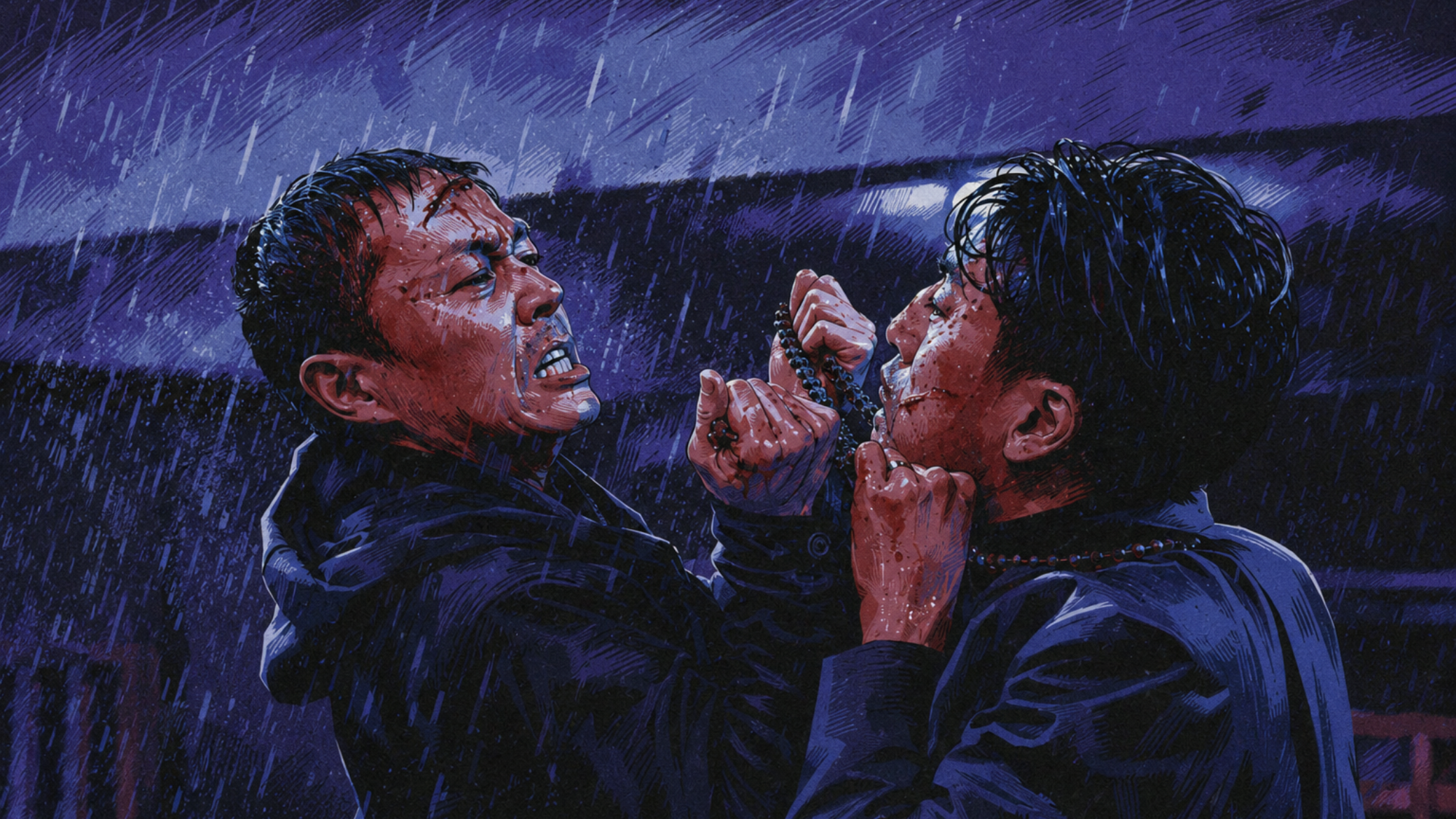
Kenji Tanigaki’s The Furious revives Hong Kong martial arts cinema with brutal, practical fights and real emotional force.
Just so we’re clear, The Furious has absolutely no interest in apologizing for being a martial arts movie. That may sound like a low bar, but in the current action landscape, where half the genre seems embarrassed by bodies unless they arrive pre-rendered, it feels almost revolutionary. Kenji Tanigaki’s film refuses to treat action as garnish, trailer fuel, or a mandatory third-act tax. It treats action as an ancient art form. A language. People fight because dialogue has failed them. Institutions have rotted. Children have vanished. And every polite avenue toward justice has closed its shutters.
That gives The Furious a familiar shape. Wang Wei, played by Xie Miao (My Father is a Hero), is a handyman father whose daughter Rainy is kidnapped by a criminal network while the police offer him paperwork, shrugs, and the usual bureaucratic anesthetic. He finds an unlikely partner in Navin, played by Joe Taslim (The Raid: Redemption), a journalist whose wife disappeared while investigating the same trafficking ring. Together, they punch, kick, crash, and claw their way through a human machinery of corruption that stretches from street-level predators to wealthy men with spotless shirts and bloodless vocabularies.
On paper, this an old, creaking engine. The kidnapped daughter, the vigilante father, the rotten cops, the trafficking ring, the unlikely ally with a personal stake. These parts have sat in the action-thriller garage for decades. Taken alone squeezed a whole late-career subgenre out of this setup.
But The Furious understands something many of its contemporaries, even John Wick to some extent, have forgotten. Originality in action cinema often comes less from the premise than from the execution. The question is not “Have we seen a father rescue his daughter before?” The question is “Have we seen this body move through this room this way?” Here, the answer keeps being thrillingly yes.
The Furious has a secret weapon.

Tanigaki, coming off his action work on Twilight of the Warriors: Walled In, builds The Furious as both a revival and an argument for more. The film is clearly a return to Hong Kong martial arts cinema’s primal virtues of The Raid variety. Clear geography, visible performers, real impacts, wide shots that invite the audience to admire the actor rather than the editor. That philosophy matters because the film’s best scenes aren’t chopped into meaningless confetti. They unfold. They breathe. Most importantly, they let us understand where people stand. What they want, how they fail, how they recover. Which poor henchman is about to discover the load-bearing properties of his own face.
That last part is the secret weapon. The Furious is not merely “well choreographed,” the way people use that phrase when a movie contains a few competent kicks and a nice hallway. Its fights have a three-act structure. A plot. Action choreographer Kensuke Sonomura approaches combat as storytelling, and you can feel that in the way each set piece escalates.
A fight begins with a problem, complicates itself, turns, then resolves through a specific physical idea. Someone wins because they notice an angle, exploit a rhythm, weaponize a surface, or adapt faster than the other guy. That makes the action legible in the emotional sense as much as the spatial one. You see what happens. Then you understand why it happens.
Dueling fighting styles.

Xie Miao gives the film its spine. Wang Wei is mute, and The Furious wisely refuses to treat that as a gimmick. No, his silence changes the movie’s entire dramatic temperature. He communicates through sign language, expression, posture, and violence, and the film turns his body into an instrument of both feeling and consequence. Xie’s fighting style here is especially fascinating because it often denies the clean extension of traditional screen combat.
For example, Wang doesn’t always punch or kick from a satisfying distance. He crowds, crashes, checks, smothers. Shoulders, hips, knees, momentum — everything becomes his vocabulary of mayhem. The result makes him feel less like a superhero than a desperate parent converting grief into forward motion.
Taslim’s Navin provides a smart counterweight. He brings more verbal texture and visible panic to the movie, and his journalist angle gives the story a wider moral frame. Wang wants his daughter. Navin wants the truth, and maybe absolution for failing to understand the danger his wife found. Together, they turn the film’s revenge plot into something closer to an exposure plot. The villains need defeating, yes. But they also need a dragging into the light. That distinction gives one of the later sequences real charge, turning spectatorship into evidence. The world has to watch what has become of their city because the institutions inside the city would rather look away.
A blunt plot with blunt-force trauma.

That institutional rot gives The Furious its bruised, while admittedly simplistic contemporary edge. The movie’s criminals operate because money insulates them, police hierarchy protects them, and poor communities become hunting grounds for people who assume nobody important will care. This is where the film’s bluntness becomes a strength. At no point does it overcomplicate evil into prestige-TV mush. Or ask us to admire the traffickers’ business model. It simply says the system has failed children, then it hands the problem to a group of actors capable of making that failure hurt in full-body contact.
And then there is the finale, a downtown melee that plays like the film cashing every check it wrote along the way. Multi-person action scenes often become polite turn-taking, with one pair fighting while everyone else waits for their cue like they’re at a deli counter.
The Furious goes for the hard version. Shifting targets, unstable alliances, simultaneous threats, and a sense of bodies constantly interrupting each other’s plans. It feels chaotic without becoming chaos in the wrong direction. That is a tiny miracle of staging. As the scene expands, it also grows even more complex. It lets the whole ensemble collide until the movie’s ideas about style, trust, physicality, and moral urgency all occupy the same sweaty arena.
The bottom line.

The film’s limitations belong mostly to its genre skeleton. The trafficking plot gives The Furious moral propulsion, but it also relies on familiar shorthand. Bad guys sneer. Rich men posture. Corrupt officers bark orders with the subtlety of a falling safe. This movie never promises psychological surprise. Only physical revelation. Every time the script reaches for stock-photo architecture, the action finds a new window to throw somebody through.
And that tradeoff feels more than fair. The Furious is a reminder that martial arts cinema needs recommitment even more than reinvention. It needs performers who can move, directors who know where to put the camera, choreographers who build fights with dramatic logic. Producers willing to bet that an audience can still feel the difference between an image manufactured to look dangerous and a human body doing something astonishing in real space.
So The Furious may not be ultimate in the cosmic, engraved-on-a-mountain sense. But as a statement of purpose, it comes awfully close. It kicks ass, yes, but more importantly, it remembers why ass-kicking ever mattered onscreen in the first place. Granted, it’s not The Raid 3. But it does know exactly which building The Raid kicked the door open on.
The Furious hits theaters on June 12. Watch the trailer here.
Images courtesy of Lionsgate.