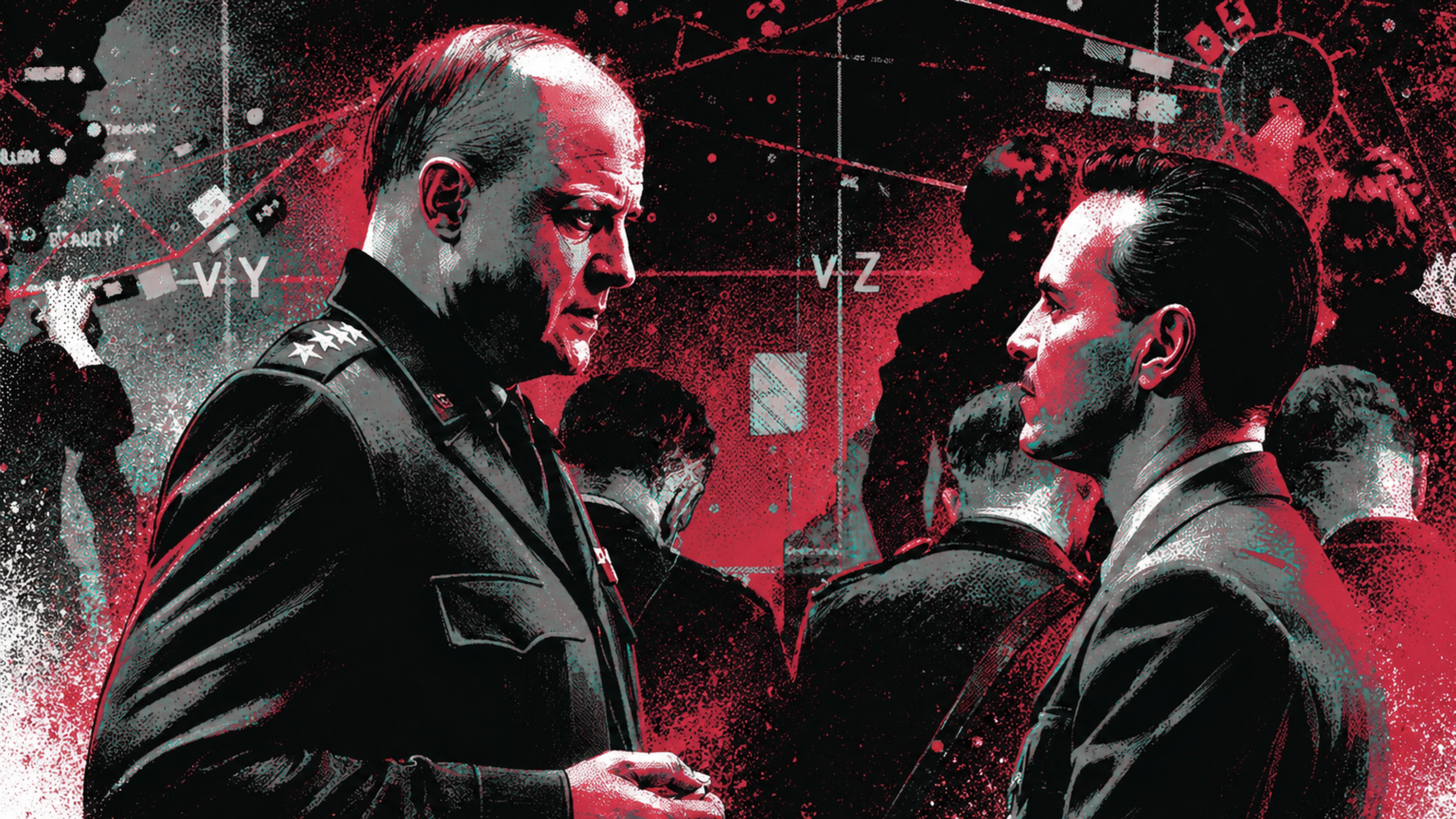
Anthony Maras turns the D-Day weather forecast into a sturdy argument play in Pressure. While Andrew Scott and Brendan Fraser make an old formula feel furious.
Somewhere right now a person stands in a conference room, holding a chart that says the thing nobody wants to hear, watching a powerful man’s face decide whether to believe it. That scene plays out in boardrooms and hospital wards and city halls every single day, and it almost never makes it to the multiplex. Because it looks like nothing. Two people. A table. A piece of paper.
But Pressure understands that this quiet standoff carries more suspense than most battle sequences. And it stakes its entire running time, and a breezy one at that, on said wager.
A weatherman, a general, and 72 hours

Anthony Maras adapts Pressure from David Haig‘s 2014 West End play, which Haig co-wrote for the screen. And the film keeps its stage bones proudly intact. Nearly everything happens inside the Allied headquarters at Southwick House, where maps cover the walls and a clock runs down toward an invasion that will decide the war.
Group Captain James Stagg (Andrew Scott), a punctilious Scottish meteorologist, arrives with 61 hours left on that clock and a single job: tell General Dwight Eisenhower (Brendan Fraser) which day the Channel will allow the largest seaborne assault in history.
Stagg reads the present. His American rival, Irving Krick (Chris Messina, all oily charm), reads the past, pulling out “every single weather chart for Northern Europe since 1900” and promising the brass exactly the calm, sunny Monday they crave. Stagg sees two storms barreling down on Normandy and offers the answer that lands like an insult to a room full of men with 7,000 ships ready to sail: wait.
Around this collision Maras arranges his supporting players. They include Kerry Condon as Kay Summersby, Eisenhower’s driver and aide and the film’s steadiest moral compass. Also, Damian Lewis as a gloriously supercilious Montgomery, who treats the weather itself as a failure of nerve.
What the film reaches for

Pressure wants to make a hero out of restraint, and that ambition feels quietly radical in a genre built on charging forward. Most war movies celebrate the men who storm the beach. This one celebrates the man who studies the tide tables and says the beach will kill you on Monday, so we go two weeks from now.
Maras and Haig honor the central irony of the true story: the fate of the free world rested on atmospheric minutiae that no general could command, no matter how many divisions he controlled. As a result, the film locates its drama in how each man meets that powerlessness, letting the contrast do the thematic work.
That contrast turns sharply contemporary the moment Krick opens his mouth. He represents a way of knowing that flatters power. In other words, pick the data that pleases the boss, bury the rest, deliver certainty as a Hollywood product. Stagg represents the opposite and pays for it in every scene, dismissed as a Highland pessimist peddling gloom. A film set 80 years ago lands squarely in our own moment of distrusted expertise, where leaders prize the confident yes over the honest maybe.
Stagg’s refusal to perform false certainty becomes the film’s spine and its argument. He keeps insisting on the humble truth of his trade: he forecasts probability, never fact. “I’m confident the storms will come,” he tells Eisenhower. “I can’t be absolutely certain.” The whole movie lives in that gap between confidence and certainty, and asks whether a leader possesses the courage to act inside it.
How well it lands

Very well, in the sturdy, unflashy way of a film that knows exactly what it is. Andrew Scott does the kind of work that elevates good material into something you remember for at least a few years before his next remarkable turn. He plays Stagg as prickly, dour, and frequently exhausting. Also, he avoids every easy bid for our affection. So the integrity reads as armor he wears at real personal cost.
His best scenes crackle with the pleasure of a man too principled to lie and too smart to lose the argument. For instance, “I’m not insulting you,” he tells Krick with surgical calm. “I’m just describing you as a moron.” In fact, that line, and Scott’s flat delivery of it, captures the film’s entire comic register, such that it is. Specifically, the dry satisfaction of watching a careful man hold his ground against bluster.
Brendan Fraser meets him with a performance pitched a register broader and entirely right for it. His Eisenhower booms and looms and cuts right to the chase. And then, in a blink, he lets the brick-built shoulders sag under the weight of 200,000 lives. Fraser finds the frightened man inside the icon, and the two actors strike sparks precisely because they play different games — Scott’s contained chill against Fraser’s expansive heat. Put another way, their scenes give a desk-bound movie its pulse.
Bottom line

Maras keeps the clock ticking and the runtime lean at 100 minutes, a genuine mercy in an era of bloated period epics. Volker Bertelmann‘s score thrums with urgency, Jamie D. Ramsay’s camera finds warmth in the wood-paneled gloom. And the ensemble commits fully to the chamber-drama format.
The staginess remains visible throughout, and the film embraces it rather than disguising it. In fact, this plays like filmed theater of a high order, one that rewards close attention to faces and words over spectacle. A purist might wish for more air, more world beyond the headquarters walls. The film answers that wish exactly once, near the end. For a moment the movie breathes past its walls. It touches the vast human chain that a forecast actually depends on, and the effect lands just right.
Ultimately, Pressure delivers the satisfactions of a well-built traditional drama with total confidence. It has clear stakes and two great actors swinging at each other. As well as a true story told cleanly and a tight 100 minutes that respects your Sunday afternoon. It aims for the solid middle of the plate and connects squarely. Hopefully leaving you a little smarter about how close the whole thing came to disaster. Scott and Fraser carry it across the line with room to spare. And the film makes its unfashionable case for listening to the careful person in the room feel surprisingly stirring. Oh, and don’t forget to bring your dad.
Pressure is now playing in theaters. Watch the trailer here.
Images courtesy of Focus Features.